
The traditional ESG framework — especially the "E" and "S" pillars — is being reinterpreted as Europe shifts political focus away from increasing regulations toward defence, resilience, and strategic autonomy. This presents both risks and opportunities for financial institutions and fund managers who now face a unique challenge.
ESG at a Turning Point
Over the past decade, the ESG narrative has been dominated by a steady stream of new measures and frameworks, each introduced under the ambitious banner of the EU Green Deal. And while the phrase ‘in today’s rapidly evolving ESG landscape’ still kicks off many articles, its meaning has shifted. What once implied steady progress now reflects growing complexity, fatigue, and political recalibration. We witnessed a period where the alphabet soup of ESG regulations and frameworks continued to bubble, with new acronyms constantly added to the pot. Now, as the pot threatens to overflow, EU states are stepping back - diluting the mix through deregulation and growing political pushback.
At the same time, the ESG landscape is being reshaped by the EU’s ‘ReArm Europe’ plan, largely in response to the war in Ukraine. These developments are not only shifting public spending priorities but are also forcing a re-evaluation of what constitutes “socially responsible” investment in an era defined by geopolitical instability. As a consequence, this recalibration is already affecting how financial institutions think about portfolio construction, exclusion criteria, and long-term investment strategy.
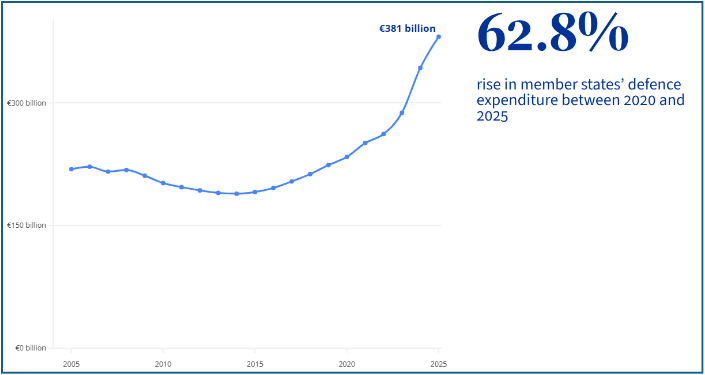
Defence expenditure (2005-2025); Source: European Defence Agency
In 2024, defence spending by EU member states rose to EUR 343 billion, marking the 10th year of continuous growth, and accounting for 1.9% of member states’ GDP. While still below Cold War-era spending levels as a share of GDP (for example, 3% of GDP was spent on defence in 1990), this marks the highest absolute defence spending in Europe since the 1980s, and the trajectory is clearly upward. Just in 2025, total defence expenditure rose by 11% as compared to 2024, and 62.8% compared to 2005.
US President Donald Trump’s rhetoric around Greenland has sharpened European awareness of its reliance on US security guarantees in strategically sensitive regions. While not a direct driver of defence spending decisions, the episode has reinforced existing debates around European strategic autonomy and exposed capability gaps in areas such as early warning, surveillance, and critical infrastructure protection. For EU policymakers and investors, Greenland serves as a tangible illustration of how social resilience extends beyond economic and social policy to include the capacity to safeguard territory, supply chains, and democratic autonomy.
How defence became an ESG outlier
These developments signal a broader rethinking of what ESG truly entails. Is it still confined to reducing emissions, upholding labour rights, and ensuring transparency? Or is it expanding to prioritize geopolitical stability, national security, and societal resilience as essential foundations for a sustainable future? At RiskSphere, we believe it does.
For years, defence and weapons manufacturing (much like tobacco and oil) were largely excluded from sustainable investment portfolios due to their perceived misalignment with core ESG values, particularly the "S" in ESG, which emphasizes peace, human rights, and the protection of civilian life. Many asset managers and ESG frameworks viewed defence as inherently linked to violence, conflict, and geopolitical instability - conditions that are directly at odds with the goals of sustainable development. This exclusion was often reinforced by negative screening practices, ethical investing norms, and regulatory interpretations that categorized weapons and military spending as controversial or harmful. As a result, defence companies were routinely left out of ESG-branded funds, regardless of their role in national security or democratic defence systems. This capital access ‘gap’ placed defence companies at a disadvantage compared to other strategically important industries (for example healthcare and pharmaceuticals), even as they operated under some of the most rigorous safety, governance, and compliance standards in the market.
The market re-evaluation of security
However, this stance is now being reconsidered in light of the war in Ukraine, rising geopolitical tensions, and a growing recognition that security and stability are, in fact, prerequisites for sustainable societies. The notion that Europe has long benefited from a "peace dividend" shielded by US defence spending has brought renewed urgency for European nations to significantly step up their own efforts to protect democratic institutions, societal values, and economic resilience. Even ESG ratings agencies like Sustainalytics are taking a more differentiated view highlighting the aerospace and defence sector as high-risk due to complex regulatory and safety issues, while using tools such as the Controversial Weapons Radar to distinguish between conventional defence operations and those linked to banned or inhumane weapons. This allows for more nuanced assessments, enabling responsibly managed defence companies to be judged on ESG performance rather than being completely excluded. Importantly, this conceptual shift is being reinforced by market performance. As investors reassess the role of defence in sustainable finance, they are also recognising its growing profitability.
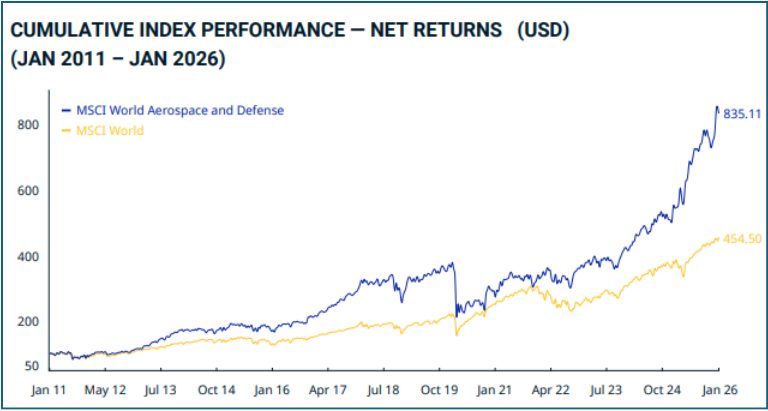
Aerospace and Defence stocks are increasingly outperforming the market in recent years; Source: MSCI
Defence is starting to be reframed not only as compatible with ESG but essential to the "S" in ESG—security and societal stability. Responding to this momentum, Euronext in May 2025 launched new thematic indices focused on energy, security, and geostrategy, signalling increased institutional support for a broader, more strategic interpretation of sustainability.
At the regulatory level, the European Commission in June 2025 proposed the “Defence readiness omnibus”. It introduces a 60-day fast-track permitting regime, simplifies administrative processes for the European Defence Fund, and clarifies how environmental, competition, and chemical regulations apply to the defence sector. Most notably, the package streamlines access to finance under InvestEU and offers guidance for sustainable investment in defence, drawing clearer lines between prohibited and permissible activities. This regulatory move reflects growing political alignment around the idea that defence readiness is not only a national obligation, but increasingly part of Europe’s long-term sustainability architecture.
No Sustainability without Security
As the ESG landscape shifts, the financial sector is being forced to reassess its investment framework. Exclusion policies that once reflexively screened out defence-related assets are now under review. There is also a growing divide between investors who want to maintain strict ethical screens and those advocating for a more pragmatic, security-conscious ESG strategy. This creates potential brand risk, greenwashing accusations, and reputational dilemmas, especially for firms with strong ESG credentials and vocal client bases. Increasingly, investors are being encouraged to differentiate between offensive and defensive capabilities when evaluating military-linked investments. A missile guidance system may raise ethical concerns; a cybersecurity shield, however, may be seen as essential to social stability. At the same time, many defence companies are adapting to this new scrutiny by enhancing transparency, embedding ESG governance practices, and publishing sustainability reports to demonstrate alignment with responsible business standards.
Labelling defence expenditure as ESG is not straightforward. For example, do we have a common definition of the boundaries of “defence” spending in an ESG context? At the June 2025 NATO summit, leaders agreed to increase defence spending to 5% of GDP by 2035. However, this benchmark includes both direct military expenditures (e.g., procurement, personnel, arms systems) and indirect spending (such as infrastructure or transport projects with potential defence applications). While this broad definition may help governments meet targets, it raises serious concerns for investors about ESG dilution. If indirect investments like bridges are framed as defence and thereby as “ESG-compliant,” nearly any sector could be relabelled under the ‘S’ for security. This opens the door to greenwashing at scale and weakens the credibility of ESG claims. Conversely, if ESG frameworks consider only direct military spending, they risk overlooking the broader ecosystem required for societal resilience and democratic defence. Striking the right balance between pragmatism and integrity will be crucial for asset managers navigating this complex terrain.
At the end of the day, including defence in ESG portfolios rather than relegating it to conventional investments acknowledges a simple but essential truth: there can be no sustainability without security. The ESG framework exists to promote long-term societal resilience, environmental protection, and strong governance. Yet none of these goals are achievable in the absence of peace, democratic stability, and the ability to defend core social values. By integrating responsible defence investments into ESG strategies, investors move beyond a one dimensional view of sustainability and recognise that security is not a competing interest but a foundational pillar, especially in a world marked by rising geopolitical threats, energy insecurity, and hybrid warfare.
ESG inclusion does more than legitimise the sector, it raises the bar for it. Defence companies in ESG portfolios are expected to meet stringent standards around transparency, governance, and international norms. This pushes the industry to improve on issues like supply chain ethics, human rights safeguards, and the avoidance of controversial or banned weaponry. It also protects the integrity of the ESG framework itself. In a time when the EU, NATO, and national governments are actively positioning defence as central to societal resilience, a rigid exclusion stance risks making ESG seem detached or outdated.
Implications for Dutch Financial Institutions
For participants in the Dutch financial sector, this shift presents a uniquely complex landscape. Dutch institutional investors, many of whom have long upheld some of Europe’s most rigorous ESG standards are now confronted with reconciling strong ethical norms with an evolving geopolitical reality. The Netherlands has historically played a leading role in sustainable finance, with pension funds and asset managers frequently setting exclusion thresholds that exceed EU regulatory requirements. But as the European Commission, Euronext, and even ratings agencies move toward frameworks that distinguish between responsible and controversial defence activities, Dutch institutions may need to re-evaluate their screening policies. Embracing the new landscape offers one possible path: aligning investment policies with national and European security priorities while still applying rigorous governance and ethical filters. Whether this becomes a strategic opportunity or a reputational challenge will depend on how swiftly and transparently financial actors engage with this changing definition of sustainability. At RiskSphere, we support financial institutions in navigating this transition, offering data-driven ESG advisory, policy alignment, and risk analysis to help clients evolve without compromising their principles.